|
|
Q & A with Kepa Junkera |
|
|
|
|
|
|
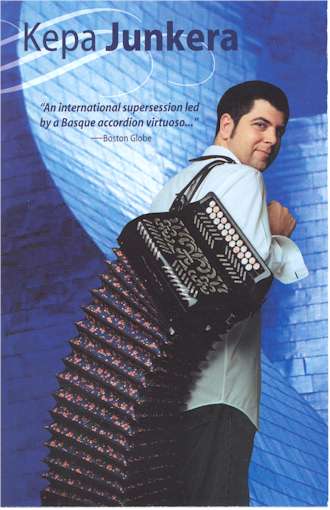
| On Friday, January 16th, Kepa Junkera
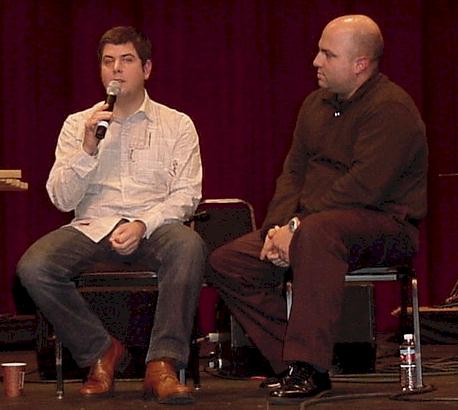
(above left) played to a sold out Dinkelspiel Auditorium on the campus of Stanford University. Before the performance, Kepa participated in a discussion session, which was moderated by Xabier Berrueta
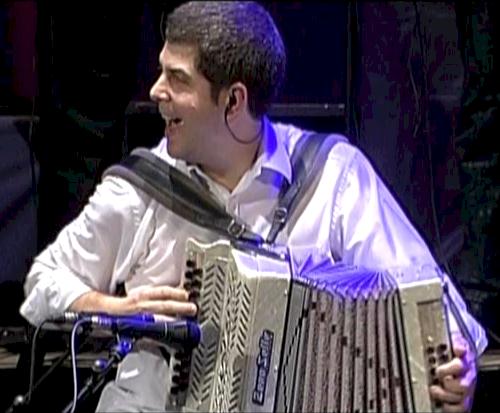
(above right). Here are some excerpts: X: Gaubon / Good Evening eta Ongi Etorri, We have with us this evening a jewel of the Basque Country – Euskal Herria – he is a master of music in many means not only in traditional Basque but has composed in other methods of music as well and he’s jumped across the pond to the West Coast and is with us this evening and we will start off with some questions that we've had and then will open to the audience and go from there. X:What first drew you to the diatonic accordion ? K: Good evening and welcome, first of all I come from Bilbao, the biggest city in the Basque Country, and traditional music comes from the rural areas, so initially it was difficult to get in touch with traditional music, my aitite (grandfather) played tambourine, which is the traditional instrument that is played with the accordion, and my mother played tambourine and danced to traditional music, and that is how I was introduced in the first place. When I first heard the accordion I liked it because it was quite lively and happy, so a friend of mine leant me one and I started playing it for fun, and that’s how I started to play. X:The trikitixa (diatonic accordion) is a rather complex instrument. What were some of your experiences growing up as you attempted to teach yourself how to play it? K: The music is complex, and the trikitixa, my accordion, is not more complex than any other instrument. When I started it was like a game for me and I did not expect to make a living at it and I just started to play melodies for fun X:As a cultural style, Basque trikitixa music is not always written down and often the only way one learns it is from the elder generation. Who were your musical influences? K: I listen to what music I could get a hold of but there wasn’t much at the time. Some of my musical influences are Mikel Laboa, Oskorri, Benito Lertxundi. X:You were raised in the city rather than the small hillside villages. How were you able to absorb so much of the native culture into your music? K: I was exposed to more traditional music since I played other traditional instruments like txistu and pandero (tambourine). You have to think, that this was in 1975, and the end of the Franco dictatorship, and many young people were researching their cultural origins. X:You have collaborated with some of the finest musicians in the world and infused numerous cultural influences into your own music. Are there any particular artists or musical styles that you would like to explore that you have not as of yet? K: I’ve been really lucky to play with people that I admire, and that I’ve been able to convince them to play with me. As I collaborated I realized how little I knew. My first dream was to play with Oskorri, a very popular group in the Basque Country, and my recent dream has been to play with Pat Metheny at the Vitoria Jazz festival this past summer.
|
|
|
|
|